The Hype Is Over. Now We Have to Make It Work.

Lisa Watts
Co-Founder & CEO
I’ve just come back from the 2026 HPA Tech Retreat in Rancho Mirage, and the tone this year felt noticeably different.
In previous years, the dominant energy around AI was excitement. Big breakthroughs. Big promises. Big possibilities. This year, the conversations were more grounded. Less about what AI might do, and more about how we actually integrate it into real production environments without breaking everything else in the process.
One speaker described AI as a “gifted teenager.” Capable of extraordinary things, but still requiring guidance, structure, and oversight. That analogy stayed with me. Because it captures exactly where we are.
AI is no longer theoretical. It’s in the pipeline. But once you put it into the pipeline, you quickly realise something: it doesn’t replace infrastructure. It exposes it.
If your workflows are fragmented, AI accelerates fragmentation.
If your governance is unclear, AI multiplies risk.
If your cost visibility is weak, AI compounds unpredictability.
The shift at HPA wasn’t about whether AI is powerful. That’s already accepted. The shift was about what it takes to make it operational.
There were candid discussions about the practical bottlenecks. The power requirements. The heat. The capital expenditure needed to support serious AI infrastructure. Sustainability wasn’t framed as a marketing goal; it was discussed as a financial reality. If you’re running AI-heavy workloads or virtual production stages, energy cost is now a line item that directly affects margin.
That’s when the conversation becomes architectural.
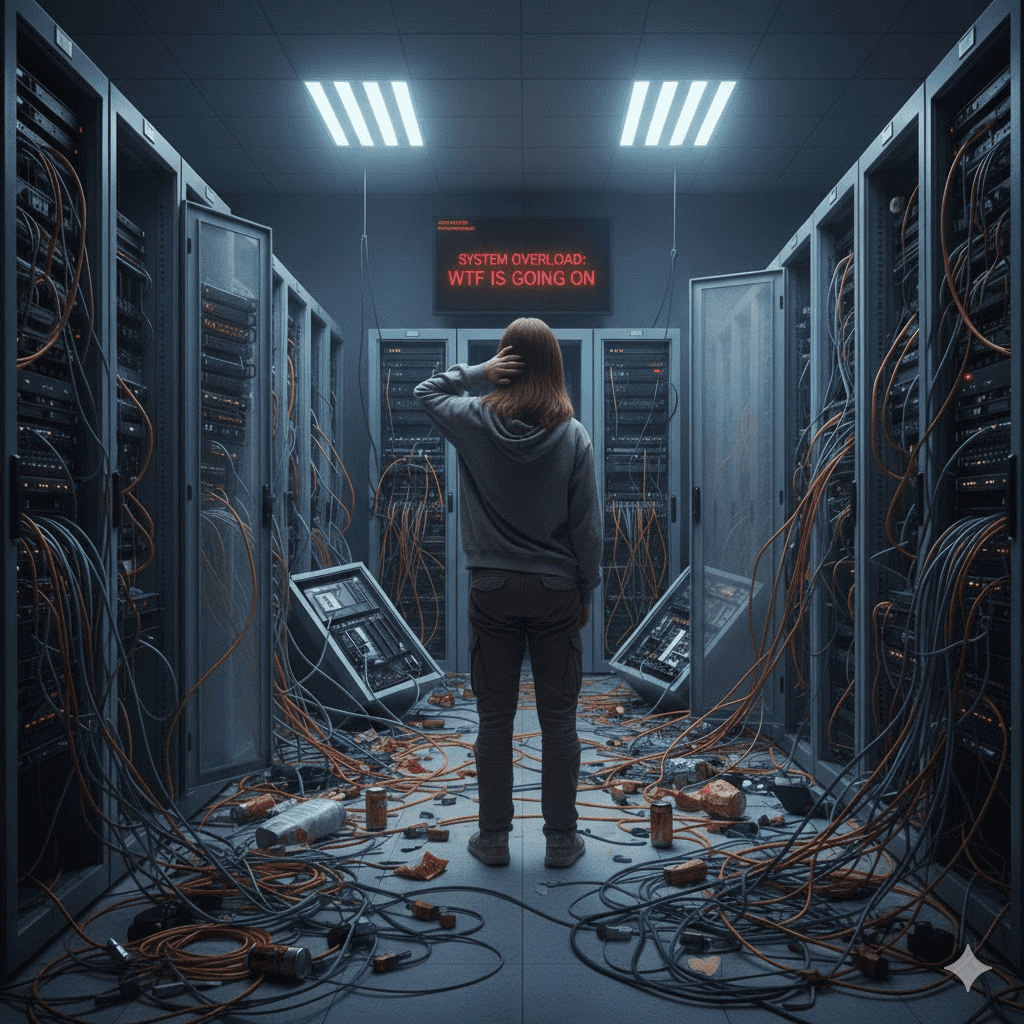
Another session was bluntly titled “WTF Is Going On?” and while it drew a few smiles, the underlying message wasn’t lighthearted. There is real anxiety in the industry. Traditional business models are under pressure. The economics of film and broadcast are shifting. Creator-driven platforms are challenging the old hierarchy. In more than one session, the phrase “every human is now a creator” came up.
What struck me wasn’t panic. It was a recognition that the next three years will demand smarter operating models.
We also saw interesting contradictions. Front projection, an older technique, was discussed as a viable alternative to LED volumes because it’s cheaper and uses less power. Private 5G was described as “necessary,” not just innovative, because spectrum congestion at major venues is becoming unmanageable. Even ATSC 3.0 resurfaced as a reminder that infrastructure transitions require decisive action to break cycles of hesitation.
The theme across all of it was not novelty. It was pragmatism.
How do we build systems that are resilient?
How do we scale without multiplying cost and risk?
How do we embed trust when AI-generated content is everywhere?
There were thoughtful sessions on data ethics and model training, including the idea that creators may need to train models only on their own work to protect IP. The conversation around provenance and authenticity was serious. In a world where synthetic content is increasingly indistinguishable from captured footage, trust is not abstract. It’s operational.
As I listened, I kept coming back to something we talk about internally at CREE8: creative velocity isn’t about speed alone. It’s about removing friction in a way that preserves control, visibility, and trust.
At HPA, no one was celebrating chaos. No one was advocating for reckless acceleration. The appetite was for systems that allow teams to move faster without losing oversight.
That’s the distinction.
Acceleration without visibility is instability.
Acceleration without control is fragility.
Acceleration without trust is reputational risk.
But when those foundations are in place, acceleration becomes leverage.
The overall sentiment this year was sober, but not pessimistic. It felt like a community taking a deep breath and deciding to focus on what actually works. There was also a sense of continuity. Mark Schubin’s final year curating the program reminded everyone that while technologies change, the human community behind this industry remains constant.
I left HPA less interested in the next headline breakthrough and more convinced that the real competitive advantage over the next decade will come from infrastructure decisions.
Not just which tools you use, but how they are orchestrated.
Not just how fast you can generate content, but how confidently you can govern it.
Not just how much you produce, but how sustainably you scale it.
The hype cycle has matured.
Now we build.